
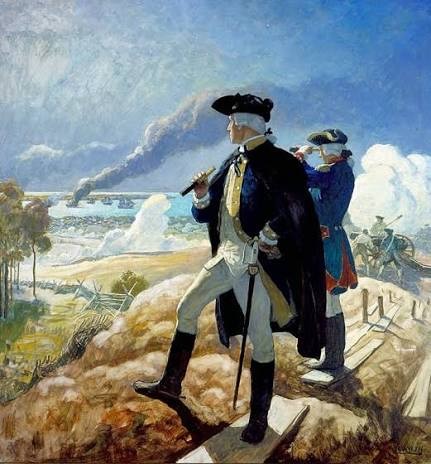
Within the compass of a single generation, the British colonies in America had raised up a company of some of the most extraordinary men in human history: orators who could sway assemblies with a word, writers capable of wielding a pen as a knight would a sword, diplomats who could shake the courts of Europe with their arguments, generals who could keep their armies from falling to despair in the face of bitter winters and crushing defeats, and leaders fit to give just laws to guide their people and institutions to nurse and raise their infant nation.
Washington, Henry, Adams, Hamilton, Jefferson, Madison, Greene, and so many others together present a question which ought to trouble any age that has grown accustomed to expecting little of its sons. How did so many men of such virtue and magnitude arise together, in a few scattered colonies, at the very hour when their nation required them?
The answer lies—in great part—in the manner in which our Founders had been educated. That education was plainly fitted to form great men. Why? Because from boyhood it taught them to look upon greatness, to admire it, and to emulate it.
Benjamin Franklin gives perhaps the clearest statement of the principle. In his Proposals Relating to the Education of Youth in Pensilvania of 1749, he placed history near the heart of education.
In this study of history, the boy would learn of the rise and fall of great states and nations, the various causes of war and means of keeping peace, the nature of human government, the beauty and necessity of virtue, and the inestimable power of eloquence. Franklin wanted the minds of boys and young men to be struck with admiration of “the Great Men whose Lives and Actions they read in History,” and then directed from that admiration into a drive to pursue the studies, arts, and languages by which such great men had become so excellent. History was to leave upon them “deep Impressions of the Beauty and Usefulness of Virtue,” of public spirit and fortitude, while the best of the ancients served as an example of what could be accomplished with wisdom, courage, eloquence, and virtue.
The great Founder Patrick Henry found one of his own ancient masters in Livy, the great Roman historian who lived through the collapse of the republic. William Wirt, writing in 1817 from testimony gathered from Henry’s family and contemporaries, tells us that Henry became enamoured of the historian, that the “grandeur of the Roman character” filled him with admiration, and he delighted most especially in Livy’s speeches. Wirt thought that the lofty manner in which Henry afterwards spoke and acted had been greatly influenced by those “noble models” set before him in that history.
Henry read of men who governed over mighty republics, resisted horrible tyrants, commanded vast armies, and won immortal honor by their unforgettable words and labors. He did not just read of the ancients as so many do today, as curiosities belonging to a dead world. He admired them, he was enamored by them, and something of the height at which they had lived entered into his own conception of what a man like himself might become.
Such admiration cannot remain idle. It drives a man to act. In these times, the student wasn’t left merely to admire the greats of the past. He was made to imitate those he admired.
At Harvard in 1767, the older students declaimed publicly, disputed weekly, argued according to the forensic manner, read and imitated celebrated speeches for the improvement of their elocution, and received instruction in theology, composition, rhetoric, and great works of the past. Franklin likewise wanted boys to compose, debate, and speak, and he saw no reason to fear their desire for victory and praise. Public disputation, he wrote, “warm[s] the Imagination, whet[s] the Industry, and strengthen[s] the natural Abilities.” The student who admired eloquence was made to attempt it.
The student, once he had read the arguments of great men, was required to make sound arguments of his own. Admiration inspired imitation, and imitation, after long, hard exercise, gave birth to habit, until such great abilities were like second nature.
All this rested within a deeply Christian—and even more particularly, Protestant—understanding of the ultimate end of such greatness. For example, the Scriptures were not just offered and received as one ancient book among many others. Rather, Scripture provided the rule by which the ancient authors were judged. Greece and Rome furnished the American student with a vast field of human struggle and achievement, of glorious republics founded and tragically corrupted, of vast armies valiantly led, of fierce tyrants resisted, of faithful friends and wicked traitors, of glory won and squandered. Here courage, eloquence, patriotism, magnanimity, and ambition were displayed on the greatest scale. Yet the Christian knew that these goods had an end far above themselves, and that magnitude without virtue might make a man terrible without making him good.
Franklin himself proposed that history be used to teach the “Excellency of the CHRISTIAN RELIGION above all others antient or modern,” alongside public virtue, political wisdom, and the examples of great men.
Thus the Americans knew that the natural ambition of young men is not something to be extinguished, but rather something to be disciplined, governed, ordered, and allowed to flourish, all to the glory of our Creator.
John Adams expressed the matter with unusual force in a letter to his wife, Abigail, in October of 1775. “The virtues and powers to which men may be trained,” he wrote, “by early education and constant discipline, are truly sublime and astonishing.” He desired that their children should possess “an ambition to excel in every capacity, faculty, and virtue,” that their minds should be elevated, their courage exalted, their industry animated, and even their bodies hardened. There is something wonderfully and terribly foreign to our own educational timidity in the phrase, and it’s something worth trying to attain once again.
Adams had none of the cowardice of our day: he had no fear that his sons might desire excellence too ardently. He feared far more that great capacities with which they had been endowed would go uncultivated. Education in its greatest form ought therefore to raise up the whole man to greatness, directing his every faculty toward the highest excellence of which he was capable.
Few scenes better display the fruit of such an education than Alexander Hamilton at Valley Forge. In the winter of 1777–1778, while serving Washington in the midst of the great War for American Independence, Hamilton sat reading Plutarch. In his paybook he took notes on Theseus and Romulus, Lycurgus and Numa, attending to founders and lawgivers, constitutions and senates, monarchy and tyranny, religion and education. One ought to dwell upon the striking circumstances of his study. Hamilton wasn’t just some schoolboy with fantasies of glory and fame. He was a young man, scarcely more than twenty years old, serving at the right hand of the commander of a revolutionary army, while the independence of his country still hung in the balance. Yet there he was, still sitting at the feet of the men who had founded and governed nations two thousand years before him. In the midst of his winter quarters, Hamilton had Plutarch to lead him as his ancient guide, just as Virgil led Dante in his journey through the infernal realms. If only we could be so free of our chronological snobbery as Hamilton, we too might look to the great men of the past to guide us.
Now, one may rightly note that education alone could hardly promise another Hamilton, Henry, or Adams.
Greatness cannot be manufactured, to be sure, and Providence has never distributed His gifts to all men in equal measure. But even still, a people may determine what such gifts will be met with when they first awaken. We could slay all wonder, stamp out all aspiration, sap all potential, and starve all strength, as we so often do in our education today. Or, like the people of the American Colonies, we may become a people in which great men can flourish in all their God-given gifts. We may place worthy objects of contemplation before their bright imaginations, furnish their ambition with noble examples, discipline their natural powers through long exercise, and teach a young man how his strength ought to be spent. The old education could never give Henry his voice or Hamilton his genius. But it’s the very means by which Henry’s voice found the words to speak and Hamilton’s genius found a worthy mission to fulfill.
And here we see that the old education speaks directly to us, even in our modern blindness. We still hold the same Scriptures. Livy and Plutarch can be read at a cost insignificant compared to that of an evening’s entertainment. The ancient tongues of Latin and Greek still stand ready to be spoken. The histories sit, waiting to be read. The speeches of the past live on to be studied and imitated. And the great men of former ages are no farther from our reach than the first pages of an old book. What remains for us is that we must once again grow to expect much of our sons, and that our sons must expect much of themselves.
So now I implore you: Take up the great books. Read hungrily. Write feverishly. Learn to speak great and inspiring words to lead the souls of your fellow men. Strengthen your body and govern its appetites. Study the lives of men of the past far greater than yourself, and seek the company of good men among those still with us on Earth. Thirst for glory and honor enough to become worthy of them. Take up duties before you imagine yourself ready for them. Pray that whatever gifts God has given you may neither lie dormant nor be squandered on vain, fleeting pleasures.
If America would again have great men rise up to lead her, she must again teach her sons to emulate greatness.
“Look upon greatness until you love it, and love it until you begin to imitate it.”