
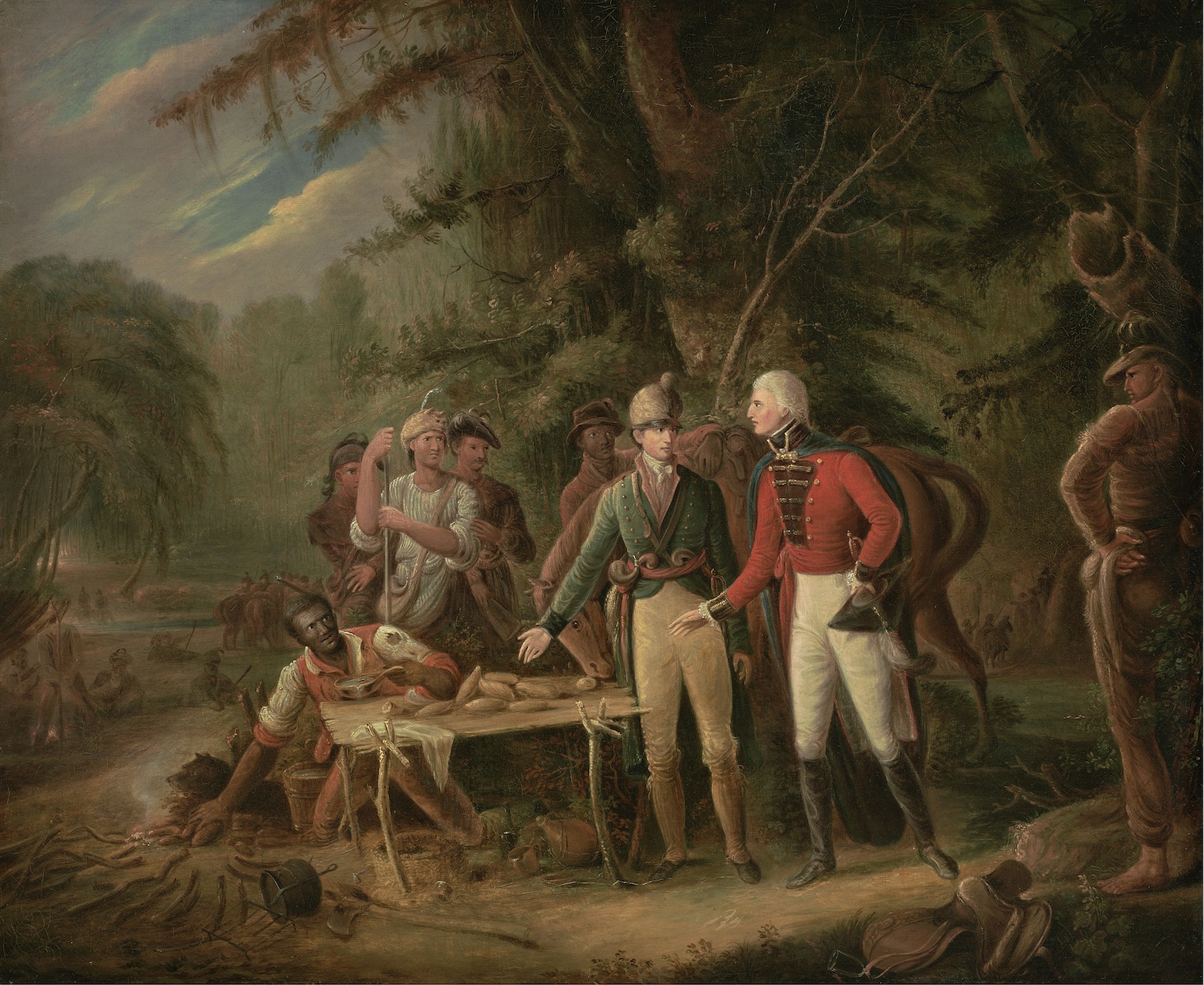
In the first part of this series, we asked how early America formed the sort of men who could build such a glorious nation as our own. But now we must look further than these great men to see the countless souls who faced the hardships and triumphs of nation-building alongside them. Washington could command only because there were men willing to shoulder muskets and march behind him through the biting winter. Henry could move an assembly with his words only because there were men prepared to hear what he had to say and willing to do something about it. Adams, Hamilton, Madison, and the like could frame constitutions and laws only because there was already a people whose common good those constitutions and laws were meant to secure. Just as great men were necessary to build the nation, patriots were necessary to constitute it.
But what exactly is a patriot?
The Romans had a word more apt than any we commonly use today to describe the virtue of the patriot: pietas. Cicero described it as that virtue which preserves our duty toward our country, our parents, and those joined to us by blood. These three groups are put together as owed a particular commitment, and for good reason, though it may not be apparent to our modern ears. A man did not choose his own parents, and he certainly didn’t make himself their son. Neither did the man choose his own country, and much less did he make that country into which he was born, invent its language, cultivate its customs, fight the battles by which it was secured, write the laws he inherited, or bury the fathers whose graves surround him. No, the man simply received these things. And since he had received them, he owed something in return. He owed, to his family and his country, pietas.
Patriotism, in this older sense, wasn’t an ideological commitment. It was filial. It was the duty of all in a nation.
This is the great thing which early American education understood. It formed patriots so remarkably well because it taught the young to receive their civilization as an inheritance, and therefore to regard themselves as debtors to their God, their fathers, their country, and, eventually, all those descendants and countrymen who would come after them. As Edmund Burke rightly notes, society is “a partnership not only between those who are living, but between those who are living, those who are dead, and those who are to be born.”
Knowing the principles upon which a country is governed is not yet the same thing as loving it.
A boy might know every branch of the federal government, be able to give a defense of the inalienable rights of men, and explain the nature and necessity of republicanism, all while feeling no more affection for America than he does for some foreign state whose constitution he happened to study.
You can’t just memorize pietas.
Rather, pietas requires the country to live first in the imagination.
Before the boy can explain the exact nature of his inheritance, he starts to taste of it. All those stories of great men of old, the graves he walks past in the churchyard every Sunday, battles he hears about in his bedtime stories, patriotic songs, old prayers, holidays, monuments, stories of treachery and courage, heroes and villains—all of these come before he’s ever sat through a class on American history. By the time he is old enough to sit and think carefully about his country, he knows what sort of things his people honor and remember.
The Romans educated their sons in much the same way. A Roman boy grew up on the stories of Brutus, Scipio, Regulus, Cincinnatus, and in these stories his public duty was made apparent to him.
Christianity took this very model of enculturation and perfected it, offering a much larger history with far greater implications of salvation and redemption. And so the great patriarchs and judges of Scripture, the prophets and kings of Israel and the apostles of Our Lord, martyrs, reformers, Christian princes, the old heroes of Greece and Rome, the Nine Worthies, and eventually America’s own founders could all furnish the imagination and cultivate the loves of the same Christian boy.
With all this in mind, we must remember that no education can give equal weight to every man and every deed. Nor should it. We preserve only some graves. We commemorate only some battles. We name cities and roads for particular men. We repeat only a few of many stories. A civilization always decides what it wishes its children to remember.
We might call that, if I may be so bold, a kind of righteous propaganda.
Propaganda, whatever you think of the word, need not mean deceit. In fact, more deceitful than any propaganda is pretending that education can avoid choosing what deserves attention. What we must ask ourselves is whether the things selected to be remembered and shared are true and good, and whether the loves and affections produced by them are just.
Take Washington. We deliberately hand down the story of his resignation because we want our sons to admire the sort of man who can possess enormous power and willingly surrender it. This is certainly propaganda in the plain sense that one is deliberately propagating a story in order that those who hear it might learn to admire a certain kind of man. But aside from being propaganda, it is also true, and the admiration that it seeks to produce is good.
And this is how you yourself came to believe, rightly, that Washington is such a good and admirable man, and further why you love the country he built. History gives rise to myth, and myth gives rise to affection, and affection gives rise to pietas.
In December of 1783, after eight years at the head of the Continental Army, Washington surrendered his commission to Congress and went home to Mount Vernon. The act gave our young nation one of the first great stories of virtue that we would set as an example before all our young men. Just as the Roman boys grew up on stories of Cincinnatus leaving his farm to save his republic and then laying down power when the danger passed, we now hear of Washington doing the same. He became our Cincinnatus, and so gave this old virtue a new, American form, just as countless other figures in our history form the basis of our unique American mythology.
Now, it is important to note that American education did not begin by tearing children loose from Greece, Rome, Israel, or England and asking them to contemplate America and her history alone. As we discussed in the first part of this series, the men who founded our republic had themselves been raised upon those older inheritances. America isn’t the only part of this great inheritance of stories.
But now it had stories of its own.
Washington’s resignation, speeches from the Revolution, accounts of the great struggles in the War for Independence, and lives of great American men began to find their way into the books of schoolboys, that our inheritance might be passed on to them. By the early nineteenth century, we had children reading The Patriot’s Monitor, a schoolbook that, as it says on its title page, was designed to “impress and perpetuate the first principles of the Revolution on the minds of youth.”
The end of such education was clear: the young were to remember what came before them, and in remembering, they were to learn what sort of people they belonged to.
Now we must look at perhaps the clearest picture of what such patriotism looked like. Not from a great statesman or some great philosopher, but from an old soldier named Levi Preston.
In 1842, Mellen Chamberlain was a young man of about twenty-one when he met Preston, then just over ninety years old. The old captain had been among the minutemen in Massachusetts who went out on April 19, 1775, when British regulars marched toward Lexington and Concord. Chamberlain, who had been studying the Revolution at Dartmouth, wanted to know what had actually driven men like Preston to fight at the very beginning of the war.
And so he began by asking Preston about the explanations familiar to him from the histories.
Surely Preston and his fellows had taken to arms because of the intolerable British oppression? But Preston told him that he had not felt oppressed.
Then perhaps it was the awful Stamp Act? Preston replied that he had never so much as seen one of those stamps, and couldn’t remember ever paying anything because of them. What about the tax on tea? Preston never even drank the stuff.
So then Chamberlain suggested that these New England farmers must have been reading Harrington, Sidney, Locke, and the great writers on liberty.
Preston had never heard of them. He said the only things he read were the Bible, the Catechism, Watts’s Psalms and Hymns, and the Almanack.
By this point Chamberlain had exhausted all the grand explanations he had brought with him, and so he finally simply asked the old soldier why he had gone out to fight.
Preston answered:
“Young man, what we meant in going for those red-coats was this: we always had governed ourselves, and we always meant to. They didn’t mean we should.”
Now that is true pietas.
Preston did not begin with some abstract theory of political right and reason his way toward a country worth defending. He began with a country. He began with a simple we.
His fathers and his neighbors and all those he knew governed themselves in a certain manner. There were inherited churches, towns, laws, liberties, memories, habits, and obligations which together constituted a people possessed of inherited habits and rights of self-government. When Preston saw those things threatened, he did not need Locke to teach him what needed to be done. It was as simple as knowing who his people were and doing what was best for them.
This does not of course mean that philosophy was unimportant, and its importance should’ve been made plain enough in our first installment. Great men require great books, rigorous thought, ancient examples, and the enlargement of mind which comes from looking far beyond one’s own little place and time.
But the ordinary patriot needs something more foundational than lofty political philosophy.
He must know that he is an heir to a great inheritance.
This is precisely what our modern education has difficulty accomplishing when it strips children of their heroes. The problem is not that we finally found the disturbing facts behind our history. This is obviously absurd. We ought to know such things, and we always have known them. No doctrine of pietas requires us to call evil good, and no country is honored by self-flattering lies.
The problem is when this sort of detachment, this dethroning of the great men of the past, becomes itself the object of education.
The child in our day is taught how every story was fabricated before he learns why anyone ever treasured it. The hero is first presented through a list of all his supposed failures. The memories animating our nation are treated as nothing more than something to be unmasked, problematized, and explained away. The boy learns to stand outside his inheritance and tear it all down before he ever tastes of its goodness.
This isn’t to say that our forefathers are above criticism. A son may certainly judge his fathers, repent of their sins, correct their errors, and preserve and amplify the good in his inheritance.
But he must first know that these men truly are his fathers.
And so we must not be ashamed to lead our sons to love their country.
Tell the stories. Name the fathers. Preserve the graves. Teach the old books. Give boys the tales of Cincinnatus and Washington, Moses and Alfred, the martyrs and the builders, men who founded their towns and men who fought for their country. Tell them about all that is worthy of love and reverence.
Let the young inherit and delight in a civilization before demanding that they sit in judgment upon it.
The first article in this short series asked us to put greatness before the eyes of our sons until they learned to desire it. Here the duty is much broader. Give them a world which reaches back through generations of fathers they did not choose and forward toward descendants they will never meet. Teach them that they have received much that they did not earn, and therefore owe much which they cannot fail to pay.
And when they speak of their country, in all its glories and all its failures, teach them to say we.
That is how we make patriots.
-Jonathon Bridges