
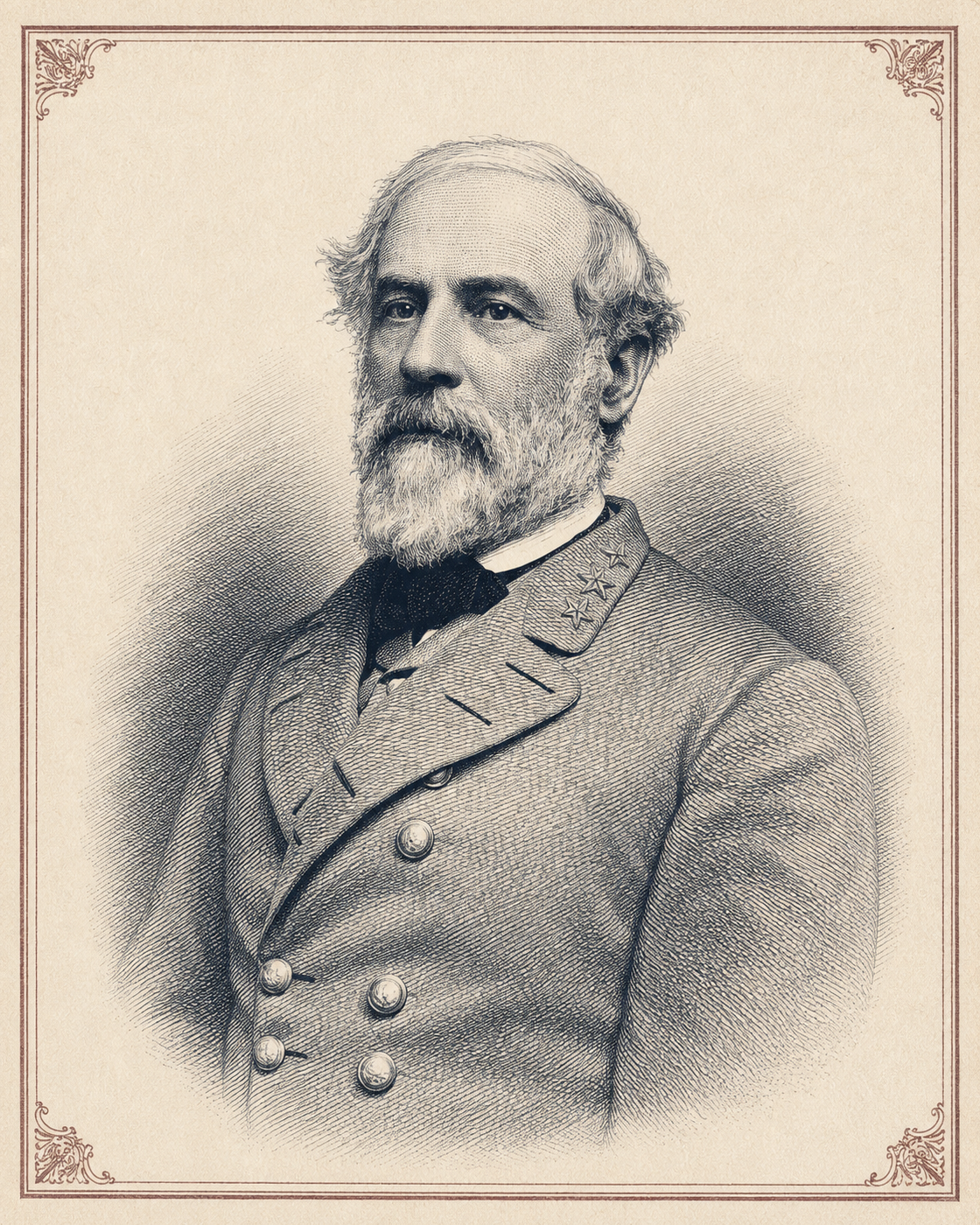
Robert E Lee, was born into a wealthy and aristocratic family His father, being a Revolutionary war hero Henry “Light-Horse Harry” Lee,exemplified great skill in command of cavalry troops in America’s war for Independence. Light-Horse Harry Lee was very close to George Washington and even is the one from which the great quote about Washington originates “First in war, first in peace, first in the hearts of country men.” Lee’s mother “Anne Carter” came from elite Virginia stock as well, being the daughter of Charles Carter, who was a dominant landowner of his time, also being a member of the house of burgesses and Governor’s Council. Lee, though born great, would go on to make the Lee name even greater than it was at his birth.
Lee spent part of his childhood within the bustling town of Alexandria, in which this town had a deep living memory of Washington himself, and saw him as their Local Patriarch. Within Alexandria was an Episocopal church, called Christ Church where Washington attended in his life as well as the Lee’s and Custis’s later.
Lee as a young man would spend time at Arlington House, which was built by George Washington’s adopted son George Washington Parke Custis, who built the home not just as a place of residence, but as a memorial to George Washington himself, which was full of stories, and even relics that personally belonged to the father of our nation. It was in his youth that George Washington Parke Custis’s daughter would begin to catch the eye of young Robert, and when the time was right, Lee would marry Mary Anne, and now through marriage had a direct familial connection to Washington himself. We see here before the prime of Lee’s life, Lee was raised, and even married into traditions, families and places that had deep connections to George Washington himself, and we can see in the manner by which Lee lived, this had a major influence upon him.
Lee would continue on in service of the army, all the way up until the war for Southern Independence. Lee would be put into a hard position, does he serve the Union, or does he serve his native soil of Virginia? Lee would ultimately resolve to serve Virginia whether within the Union or against it. Virginia would originally vote against succession, but after Fort Sumter a few weeks later Virginia would join its fellow Southern States in succeeding from the Union. Lee would be summoned to Richmond in April of 1861, and upon arrival at a ceremony in Richmond, Lee is shocked to hear this speech made by the President of the Virginia Convention, John Janey.
“Sir, we have, by this unanimous vote, expressed our conviction that you are at this day, among the living citizens of Virginia, ‘first in war.’ We pray God most fervently that you may so conduct the operations committed to your charge, that it will soon be said of you, that you are ‘first in peace;’ and when that time comes you will have earned the still prouder distinction of being ‘first in the hearts of your countrymen.’
“I will close with one more remark.
“When the Father of his Country made his last will and testament, he gave his swords to his nephews with an injunction that they should never be drawn from their scabbards, except in self-defense, or in defense of the rights and liberties of their country, and that, if drawn for the latter purpose, they should fall with them in their hands, rather than relinquish them.
“Yesterday, your mother, Virginia, placed her sword in your hand upon the implied condition that we know you will keep to the letter and in spirit, that you will draw it only in her defense, and that you will fall with it in your hand rather than that the object for which it was placed there shall fail.”¹⁶
Lee replied
“Mr. President and Gentlemen of the Convention,—Profoundly impressed with the solemnity of the occasion, for which I must say I was not prepared, I accept the position assigned me by your partiality. I would have much preferred had your choice fallen on an abler man. Trusting in Almighty God, an approving conscience, and the aid of my fellow-citizens, I devote myself to the service of my native State, in whose behalf alone will I ever again draw my sword.”
We see here in this short and brief exchange remnants and odes to George Washington himself, from the quote originally coined by Lee’s father about Washington being now applied to Lee himself, and Lee drawing the metaphorical sword of Washington, passed down to him to protect his beloved Virginia.
Lee would serve his native State of Virginia well, always punching far above his weight in regards to the size of his army compared to that of the Union’s. Doing far more with far less than the armies coming from the North. Lee would display a masterclass in commanding an army, and some to this day argue it could be considered the best in history with all the circumstances considered. With less men, less manufacturing, less food, less guns, less everything, Lee would eventually surrender to Grant at the Appomattox Court House. Lee would take the humiliation of defeat well, like a Southern Gentlemen should, and begin to move on to fixing a broken nation.
Lee would leave the army life behind once and for all, and assume the role of President at the barely surviving Washington University. The war had left it with only 40 students still enrolled, and almost bankrupt. Lee would go right to work, seeking to provide an education that was a fusion between classical education, and practical skills that could help young men rebuild our country. Under Lee, the University would in a few short years have 400 students enrolled again, and no longer facing threats of bankruptcy. A University once brought low, now restored to its former glory, a glory first stoked by a large donation of money made by none other than George Washington himself which led to the University renaming itself Washington University. Lee would go to be with his Lord in 1870, and soon after his death, the trustees of the school would rename the school to Washington and Lee University.
As we see in the brief comparison of Washington and Lee’s life here, there are many similarities that these men share, from disposition, station, career, and even motives of their life’s work. Our first Washington is lauded as a hero, and perhaps our nation is where it is today because of its rejection of our second Washington, who was the great christian general Robert E Lee.