
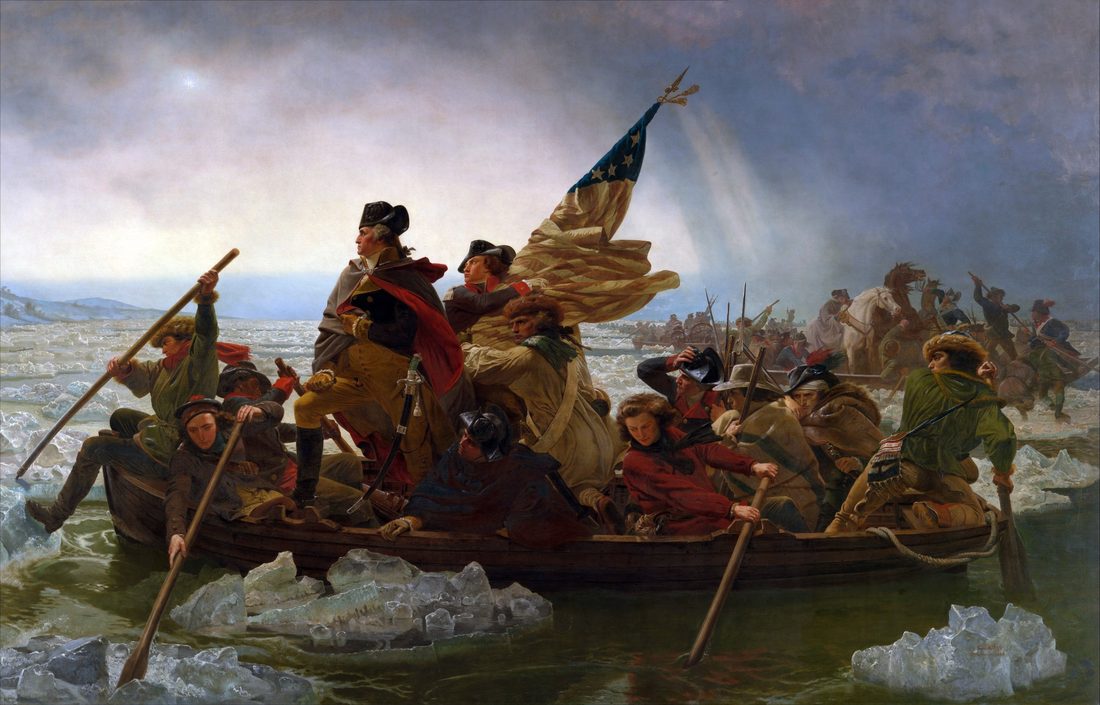
When we ponder Washington’s crossing of the Delaware, we see Washington fixed in his disposition, as if to him the fate of this surprise attack was already settled.
This must have manifested amongst his men as they followed their commander in and through the icy chasm. Perhaps his men saw what we see now for ourselves: a man fixed upon his course of fate, willing to play his part in the great drama.
Most of us no longer know the context of this hour of Washington’s life—and even that of the overall Continental Army.
The context only adds more renown to their perilous journey across the Delaware.
The Proper Context
After declaring our right of self-governance on that splendid day, July 4th, 1776, the great words of the Founders would now have to be secured through warfare. Though we had now declared independence, it was time to earn it through might.
The timeline leading up to the crossing of the Delaware.
August 27th, 1776 — The Battle of Long Island
Washington was routed and just escaped in time not to lose his entire army.
September 15th — Kip’s Bay
Forced from a defensive position, Washington was forced to withdraw. Manhattan and New York City fell to the British.
November 16th — Fort Washington Falls
British and Hessian German troops overwhelmed the American troops within the fort after successfully thwarting two initial waves of Hessian forces.
The fort would be overrun, with 59 American soldiers dying and 2,837 captured.
November 20th — Fort Lee
From there, Cornwallis, after taking Fort Washington, would cross the Hudson into New Jersey.
Washington’s men were forced to retreat so quickly that they left behind cannons, tents, food, and other important supplies.
Late November–December
Cornwallis would chase Washington’s army across New Jersey, through Newark, New Brunswick, Princeton, and Trenton, into Delaware.
November 30th
The British thought they had caused enough despair in the hearts of Americans that they began offering pardons to Americans who would abandon the rebellion and swear allegiance to the King.
Some chose to do this very thing.
December 13th
General Charles Lee, the second-highest-ranking major general, is captured by the British.
Washington himself ponders if they need to now give up.
December 18th — The Letter
Washington writes a letter to his brother. He writes that he only has 3,000 men remaining after the adverse course of events—but nevertheless, at the end of the letter, he writes:
“However, under a full persuasion of the justice of our cause, I cannot but think the prospect will brighten, although for wise purposes it is, at present, hid under a cloud.”
December 19th — Thomas Paine’s American Crisis
Thomas Paine’s American Crisis is published in Philadelphia, with its famous line:
“These are times that try men’s souls.”
There is evidence that Washington had this read to his troops.
December 25th–26th — Crossing the Delaware
Washington takes 2,400 of his men across the Delaware River, back into New Jersey, in the sleet, snow, freezing temperatures, and water.
Washington would surprise the Hessians and capture around 1,400 men.
We can see that many good men lost their lives, American cities were overtaken, some leading American men took pardons, and for many in the colonies and many under Washington’s command and even himself pondered if their fight for self-governance was over. The emerging American spirit would answer no, that our lands would belong to us, that the future of our posterity would be determined by us. Washington and his men braved the Delaware, and would eventually secure our liberties as free men before God.
Trust in God, and press on my friends.
- Cody Black.